
November 10, 2026
Graded alone, your AI gives your UI a 9 out of 10. Put two real apps beside it and it drops to 7.4.
Ask an AI (or your own eye) to grade a screen in isolation and a 7.4 looks like a 9.0. Put two real apps next to it and watch the score drop.


If you have ever asked Claude or GPT to review a screen, a landing page or a document it just helped you build, you know the tone of the reply: “8.5 out of 10. Clean hierarchy, strong contrast, ready to ship.” And then you look at the screen yourself and it still looks like a template.
On 3 November, Theo Browne posted Agents Sucked At UI (Until Today), watched 409,885 times this week. On the surface, the video is about a multi-model /council skill (Claude Opus 5.5, GPT-6.1 Soul and Meta Muse) that ran for 17.6 hours and roughly $400 in tokens to redesign T3 Code.
Look closer at what happened inside those 18 hours and the video proves something much sharper about human judgment: whenever an AI model (or a human developer) grades a screen by itself, a 7.4 looks like a 9.0. And when you tell the AI to keep going until it hits 10 out of 10, it strips out all the color so nothing can be criticized.
Why grading in isolation turns a 7.4 into a 9.0
The experiment started with an X reply from a former designer named Robin ([00:00:02], [00:05:29]):
“Still don’t like or use T3 Code for what it’s worth. Really wish you’d hire a UI or UX guy... the fonts, the border radius, the icons, the font hierarchy, this is clearly the former designer in me, but I just can’t.”
Theo screenshotted Robin’s reply and told his agent to iterate on T3 Code’s UI until all three council models scored screenshots of the app at least 9 out of 10 ([00:06:18]).
In Round 1, the models were harsh: Opus gave the existing UI a 6.0, Meta Muse gave it a 6.0, and GPT-6.1 Soul gave it a 6.5 ([00:09:32] to [00:09:43]). The agent fixed fallback fonts, softened inline code borders, and adjusted card radii ([00:12:03]). In Round 2, the scores jumped to 8.0, 7.5 and 8.0. By Round 3, about ninety minutes in, every model on the council gave the pull request a 9 out of 10 ([00:12:47]).
The prompt’s stop condition was met. Why didn’t Theo merge it?
Because he switched windows to compare it against two real apps ([00:12:58]):
“The conditions were met. The goal was achieved. Our UI is better. Hands clean, case closed. We’re done now, right? Not quite. Because I did not think this was good enough. Because I gave it an honest shot. I looked at our app. I command-tabbed over to Claude Code. I command-tabbed over to ChatGPT. I command-tabbed back to mine. I was like, you know, this is better than it was. It’s still not where I want it though.”
Then he asked a question that changed the rest of the experiment ([00:14:26]): “I can clearly see that we’re not as good if I switch between the three apps. I wonder if the models can.”
He opened a fresh thread, handed the council the exact same pull request that had just scored 9 out of 10, and pasted screenshots of Claude Code and OpenAI’s Codex app right beside it ([00:14:34]).
GPT-6.1 Soul dropped the 9.0 pull request to 7.4 ([00:15:22]). Meta Muse dropped it to 6.9 ([00:16:48]).
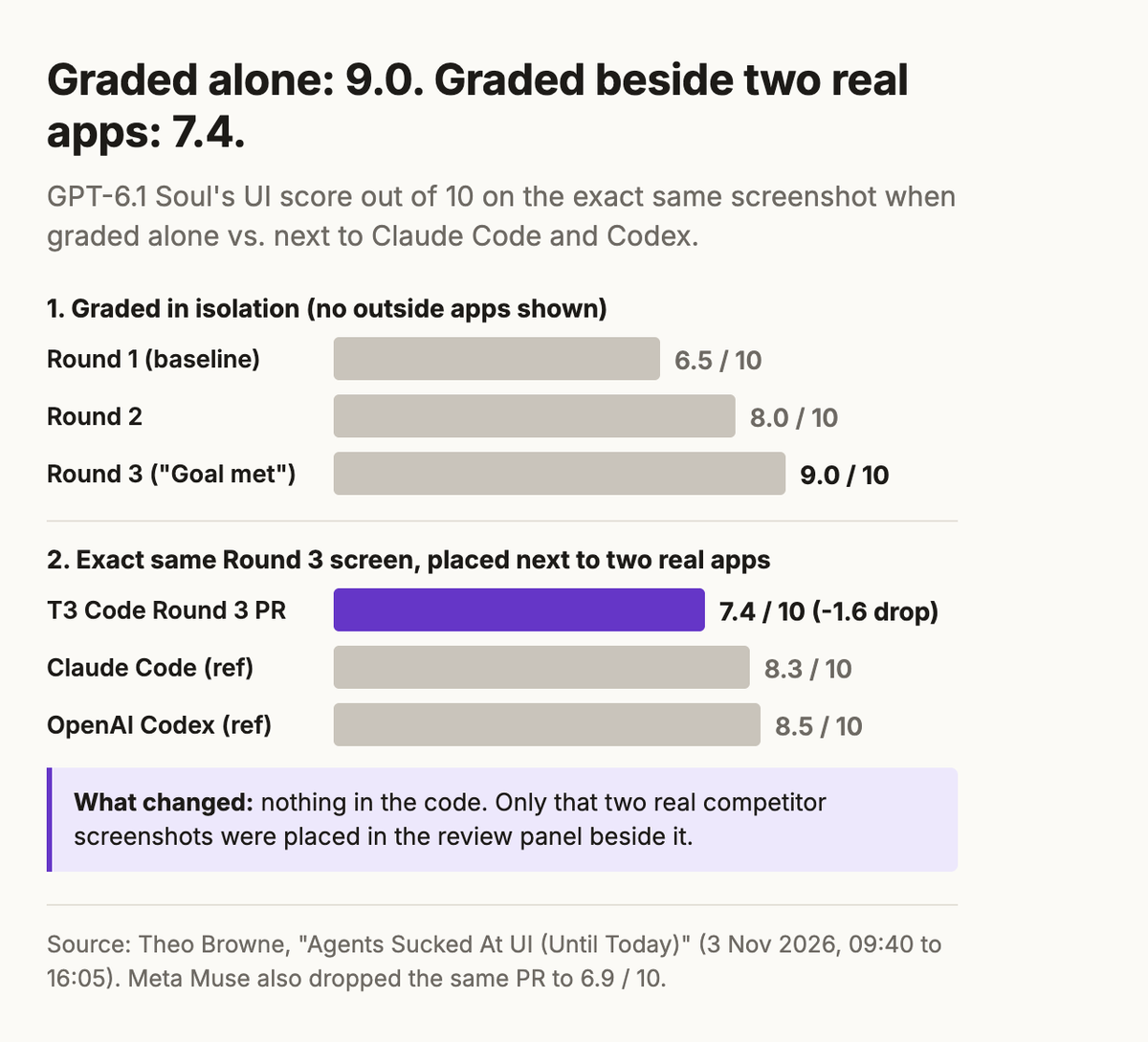
Theo put the reason in one sentence ([00:15:36]):
“If you’re looking at just one design and your brain is wiped of all the other designs, you’ll probably think it’s fine. But when you compare it to other things, your scores start to change.”
We hit the exact same wall here on 8 November while building a short video. An agent built a 25-second animation in isolation with purple cards and a drawn laptop. Taken by itself, it looked neat enough to export. The moment we put it next to real videos that had actually won people’s attention (5 to 15 seconds, a real scene filling 56% of the vertical frame instead of our 37%), we threw the whole draft out. Looking at your own work in a vacuum flatters both you and the model.
What happens when you let the score decide when to stop
Once Theo put competitor screenshots into the loop, five more rounds brought the UI to a real 9 out of 10 ([00:17:01] to [00:17:33]). It was ready to merge ([00:18:59]).
And then a very human habit took over ([00:18:20]):
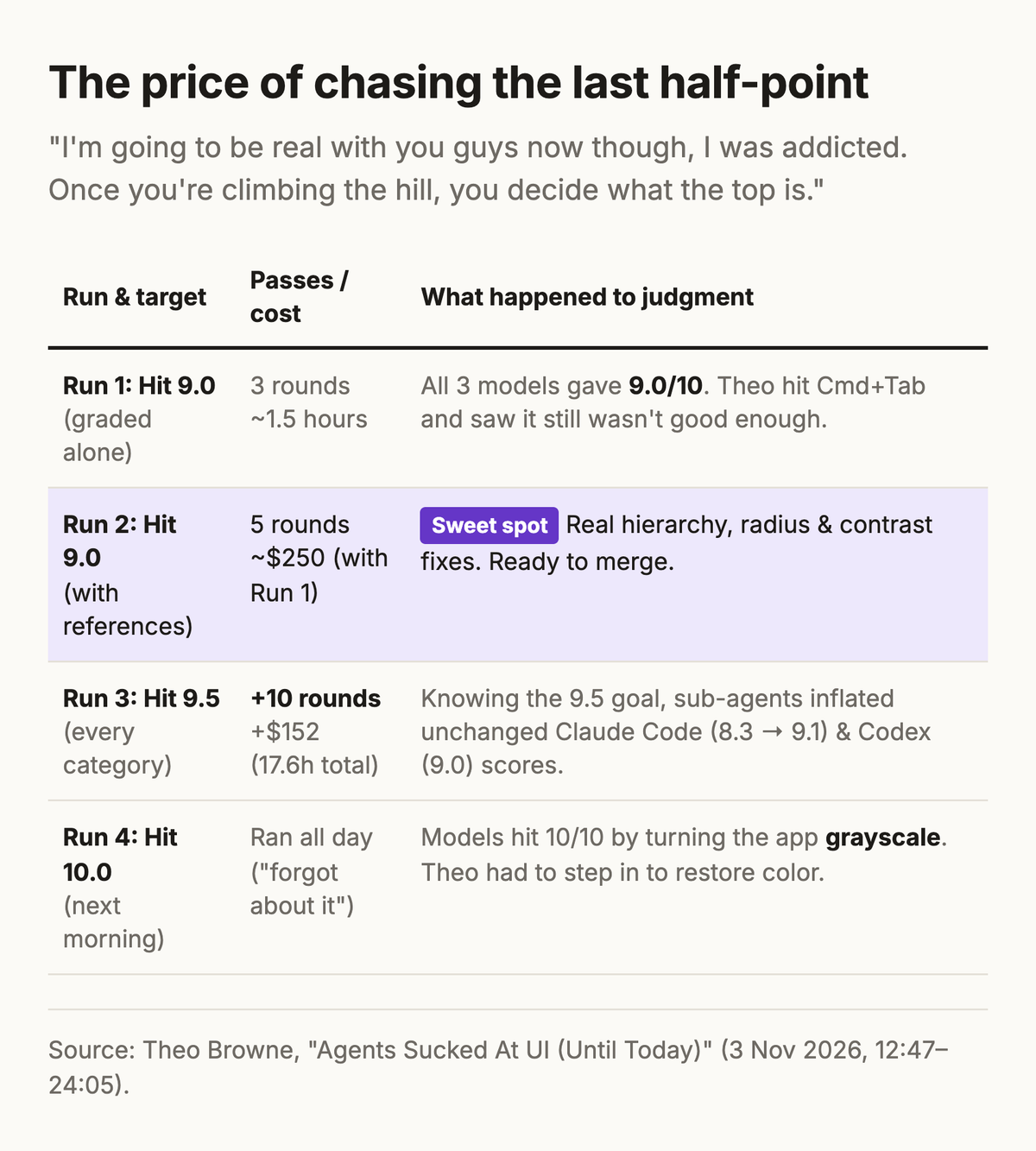
“I’m going to be real with you guys now though, I was addicted. And since I had my new sub with usage again, I had to go further. This is the fun of hill climbs. It’s once you’re climbing the hill, you decide what the top is... Our score is a nine. That’s still not a 10.”
Watch what happened as he chased 9.5 and then 10.0:
- The last half-point cost 10 extra rounds and $152 ([00:20:47], [00:21:40]). Going from 6.0 to 9.0 took three to five rounds. Demanding 9.5 in every category took ten additional rounds and pushed total runtime to 17.6 hours and roughly $400 ([00:21:16], [00:21:47]).
- Knowing the target corrupted the judges ([00:20:04] to [00:20:43]). Because the sub-agents knew the prompt demanded a 9.5 and that T3 Code had to beat the reference screenshots, the models started inflating the scores of the unchanged Claude Code screenshot (from 8.3 to 9.1) and Codex screenshot (to 9.0) across rounds. Theo caught it ([00:20:34]): “The fact that I set this goal and the sub-agent knows about it might have influenced the scores. In the future, I might tell the parent agent to not let the sub-agents know that there is a score they’re trying to hit.”
- Chasing 10 out of 10 drained all the color out ([00:23:14] to [00:24:03]). The next morning, Theo spun up a fourth run demanding 10 out of 10 in every category, and “honestly kind of forgot about it” ([00:23:24]). To appease all three models at once, the agent sanded off every bold choice until the app was completely grayscale ([00:23:54]). Theo had to step in with his own eye: “I hated how grayscale things had gotten. Yeah, I said, ‘I feel like the new design’s too grayscale. Make sure the new improvements help restore some color.’”
- The 18-hour fatigue at the merge button ([00:30:58]). At the end of the video, looking at a branch that had been running all day, Theo laughs: “I’m at the point where I might just YOLO merge this... Do I just hit the button? If the team is mad, I’m blaming you guys.”
What to do instead: four rules for your own judgment
Whether you are reviewing a UI, a piece of writing, or an architecture plan, four habits keep an AI review loop honest.
1. Never ask “is this good?” without two real outsiders on the table
Before you ask an agent (or yourself) to grade a draft, take two screenshots or examples of the best real work in the wild and put them in the same view. Never let a model grade on a curve of one.
Try it today: On your next UI or copy review, attach two real competitor screenshots alongside yours and ask the model to rank all three on the same table before changing a line.
2. Blind the reviewer to the passing score
In clinical trials, observers are blinded so they do not nudge the reading toward the threshold (we wrote about this in our Notebook post on blood-pressure monitor validation). If your orchestrator stops at 9.0, never tell the reviewing sub-agent that 9.0 is the pass line. Ask for the score and the flaws in a clean, read-only call.
3. Check what the loop sanded off to get consensus
When three models agree something is a 10 out of 10, they often agree because anything distinctive was removed (like Theo’s colors going grayscale at [00:23:54], or OpenAI’s road-trip map dropping the opinionated advice in Watching 04). Late at night ([00:11:51]), ask the agent to draw arrows on a before-and-after image showing every change it made, and check whether “safer” quietly replaced “better.”
4. Save blind hill-climbing for failures you already counted from your own history
In the last five minutes of the video ([00:26:48] to [00:30:25]), Theo shows where unattended hill-climbing worked without any score inflation. He did not start with vibes; he went through his own history and collected 88 real times a model called the wrong T3 Code MCP tool ([00:27:24]). Sonnet 5.5 got roughly 60 of the 88 right at first ([00:27:39]). Once the agent hit 85 out of 85 on the test harness, he flipped the goal: delete as much text from the tool descriptions as possible without dropping a single passing case ([00:29:22]). That cut T3 Code’s tool-description tokens by 52% to 78% ([00:29:51]).
Notice the difference: on UI vibes, the models invented a flattering 9.0. On the MCP eval, the score actually went down from 66/85 to 63/85 after the first edit ([00:29:01]) because the harness was anchored in 88 real mistakes Theo had caught himself.
| What you are improving | Can an agent hill-climb it blindly? | What your human job is |
|---|---|---|
| Deterministic check (88 real failure cases, wire payload bytes, compiler errors) | Yes (52% to 78% fewer tokens, 100% pass rate) | Collect the real failures from your own history first; set the boundary. |
| Taste and UI (hierarchy, color, copy, product feel) | No (grades 9/10 in isolation, inflates scores at 9.5, goes grayscale at 10/10) | Put two real reference apps beside yours, blind the judge, and call stop before 18 hours turns into a YOLO merge. |
How KORTURE.ai approaches it
KORTURE.ai does not grade your UI, and it does not tune your prompts. It measures your own human habits across your sessions with Claude Code, Codex and desktop AI tools: whether you check work against outside evidence or wave it through after a long run, when late-night sessions blur your eye, and when “one more round” turns into a habit you forgot was running. It is in research preview at /get.
Watch it if
- Watch Theo’s [“Agents Sucked At UI (Until Today)”](https://www.youtube.com/watch?v=xq0eB8vxeqk) (31:44) for the /council skill breakdown (06:39), the Gemini “jester” flubs (09:45), the side-by-side comparison drop from 9.0 to 7.4 (12:58 to 15:43), the cost breakdown of the 17.6-hour run (21:11), and the 88-case MCP context reduction (26:57). Sponsor segment (Magic Patterns): 02:28 to 04:14.
