
August 27, 2026
An AI Described How I Work. I Agreed. The Next Day I Threw It Out.
An AI described how I work and I agreed. A day later I threw it out. What a 1949 experiment and blood-pressure monitors say about every AI summary of you.

On 8 August, an AI read 888 of my messages to coding agents and told me how I work. I read the summary, nodded at my screen, and typed five words: “Yes this is actually me.”
If you have run Claude Code’s /insights, or read what ChatGPT’s memory has saved about you, you know the feeling I had. The description sounds right, so it must be right. Most of us judge every readout of ourselves by that one test: does it sound like me? I did too, until the next session. A 1949 classroom experiment, and the way blood-pressure monitors are approved, show why that test proves almost nothing. There is a better one, and it takes five minutes.
What happened
I am building Sense, a tool that reads how you actually work with AI. The finding I agreed with was not a careless guess.
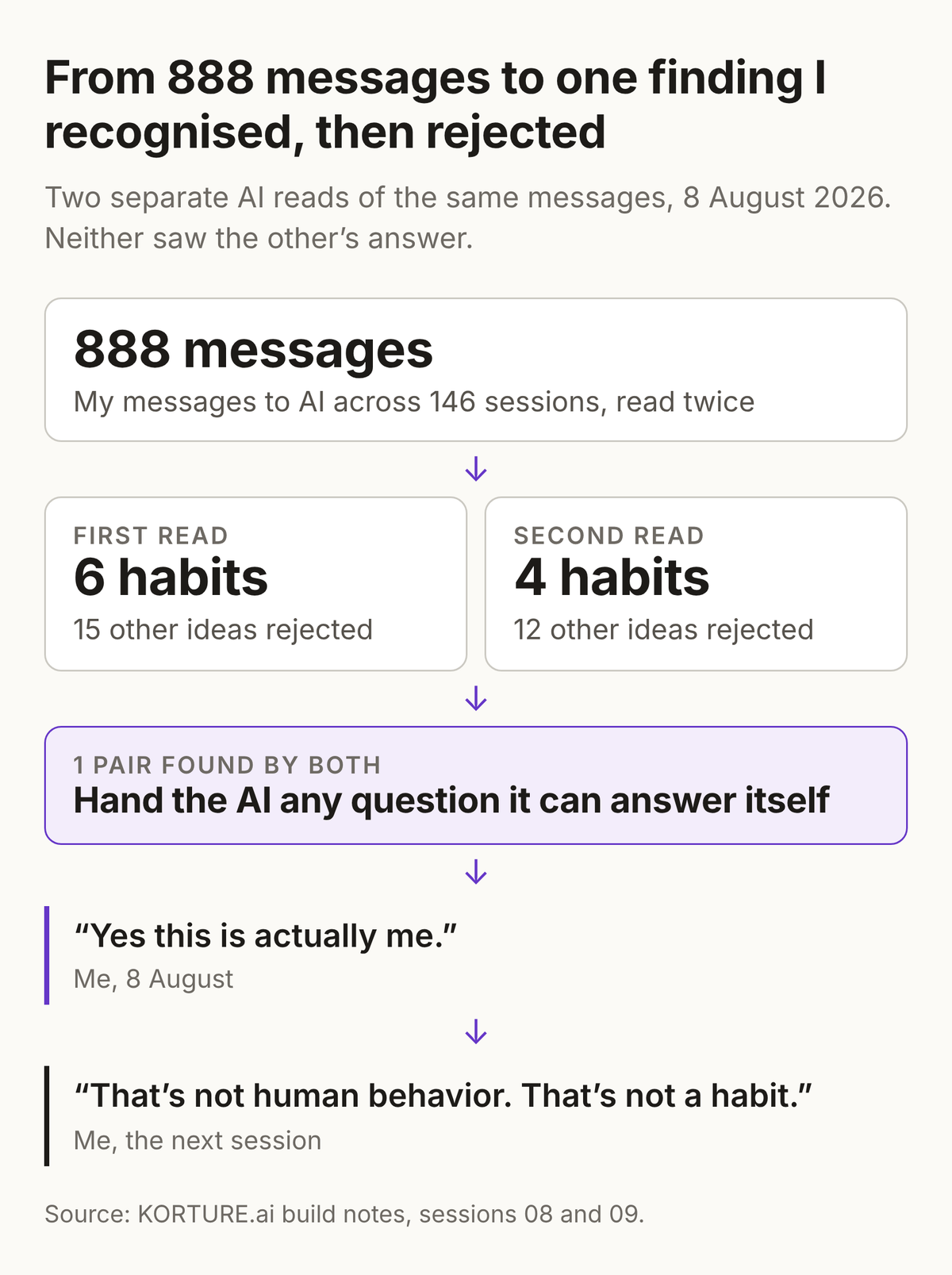
Two separate AI reads went through the same 888 messages, across 146 sessions. Neither saw the other’s answer. (Think of two detectives locked in separate rooms with the same box of evidence.) The first proposed 6 possible habits and rejected 15 other ideas. The second proposed 4 and rejected 12. Of the 10 habits, only one pair matched. Both reads cited three of the same supporting sessions and picked the same counterexample.
| First read: 6 possible habits | Second read: 4 possible habits |
|---|---|
| Answerable technical questions stay with the AI | The agent owns discoverable technical work |
| Plausible claims face a test that could disprove them | Checks on goal and meaning kept apart from mechanical checks |
| Work judged in the real screen and state | Failed directions written down before restarting |
| Unfinished work written down before a fresh session | Existing evidence used before waiting for proof |
| Automation rejected if it needs a person to keep stepping in | — |
| A fresh review before a person reviews it | — |
The habit: when the AI asks me something it could find out itself, I send the question straight back. The lead evidence was my own line from an earlier session: “Never ask me questions where you can find the answers. You are the answer finder. I am NOT the answer finder.” The plan for that session ended with one question for me: “Is this actually me?”
Why did I say yes so fast? Because it flattered me. It read like Tony Stark talking to JARVIS: decisive, no time wasted. (Severance has a scene for this. In a Wellness Session, a calm voice reads you pleasant facts about your Outie, and you sit there beaming.)
In the next session I looked again and said:
“That’s not human behavior. That’s not a habit.”
Every one of the ten habits had the same shape: when the AI does X, I tell it Y. So did the 1 to 4 rating they were read from. That describes the conversation. Telling an agent to look something up itself is how you talk to a tool that keeps stalling. If you kick a vending machine when your snack gets stuck, “values mechanical force” is a weak psychological profile. You just want your chips.
The reads had even written down a rival explanation: the habit might come from my not being a developer, from what the agent’s tools could reach, or from a run of failures in tool-heavy projects. A record of what I said to a machine was not a measurement of me.
What we checked
First, the numbers agreed with my doubt. That 1 to 4 rating, of how well each message steered the AI, was flat for three months. Across 146 sessions from 10 May to 6 August, every block of 20 sessions averaged between 2.39 and 2.63.
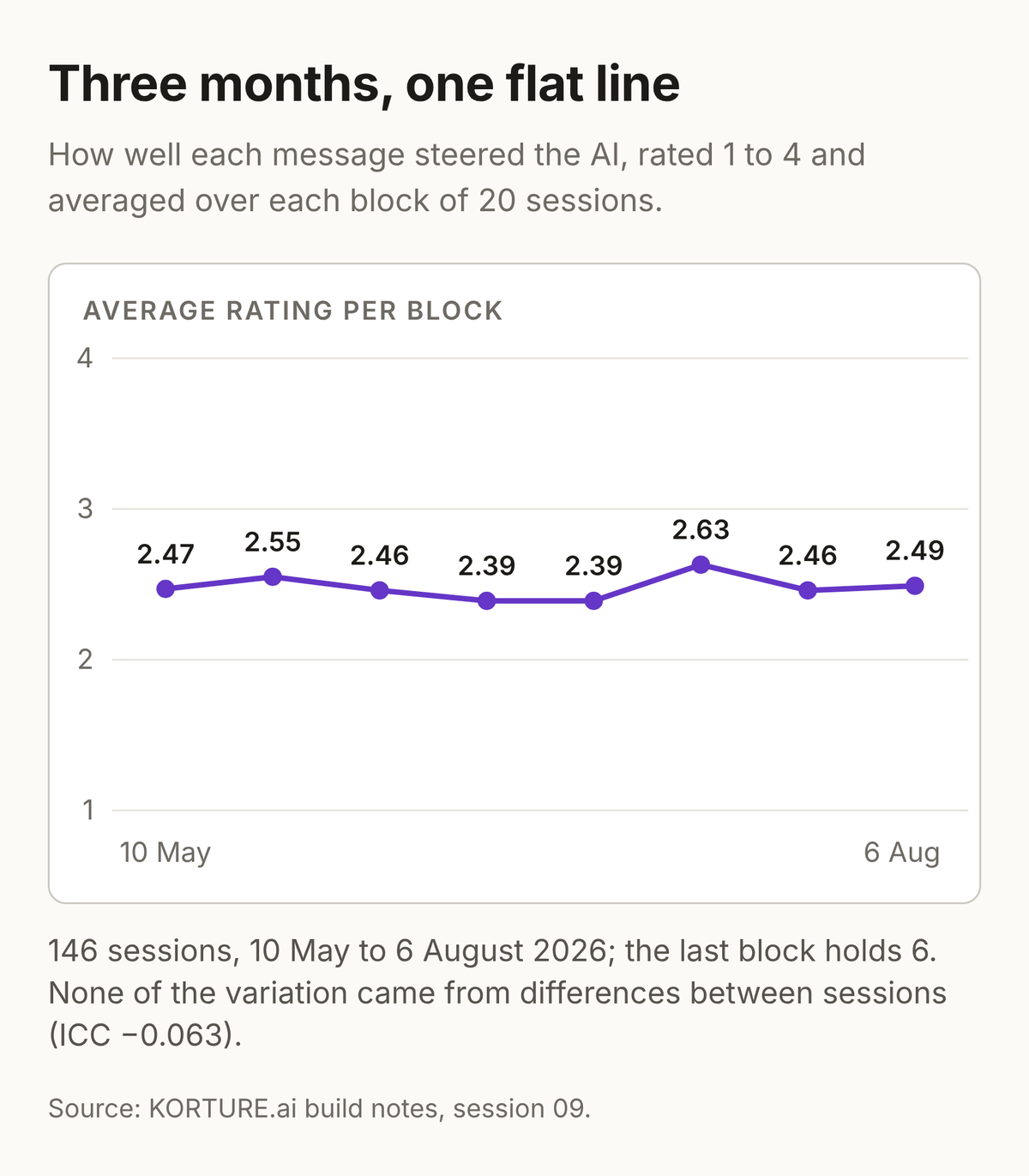
None of the variation came from differences between sessions. The rating could not tell one session from another, or May from August. A description that cannot change cannot tell you whether you did.
Second, other fields settled this long ago: one with a classroom experiment, and one with a medical standard.
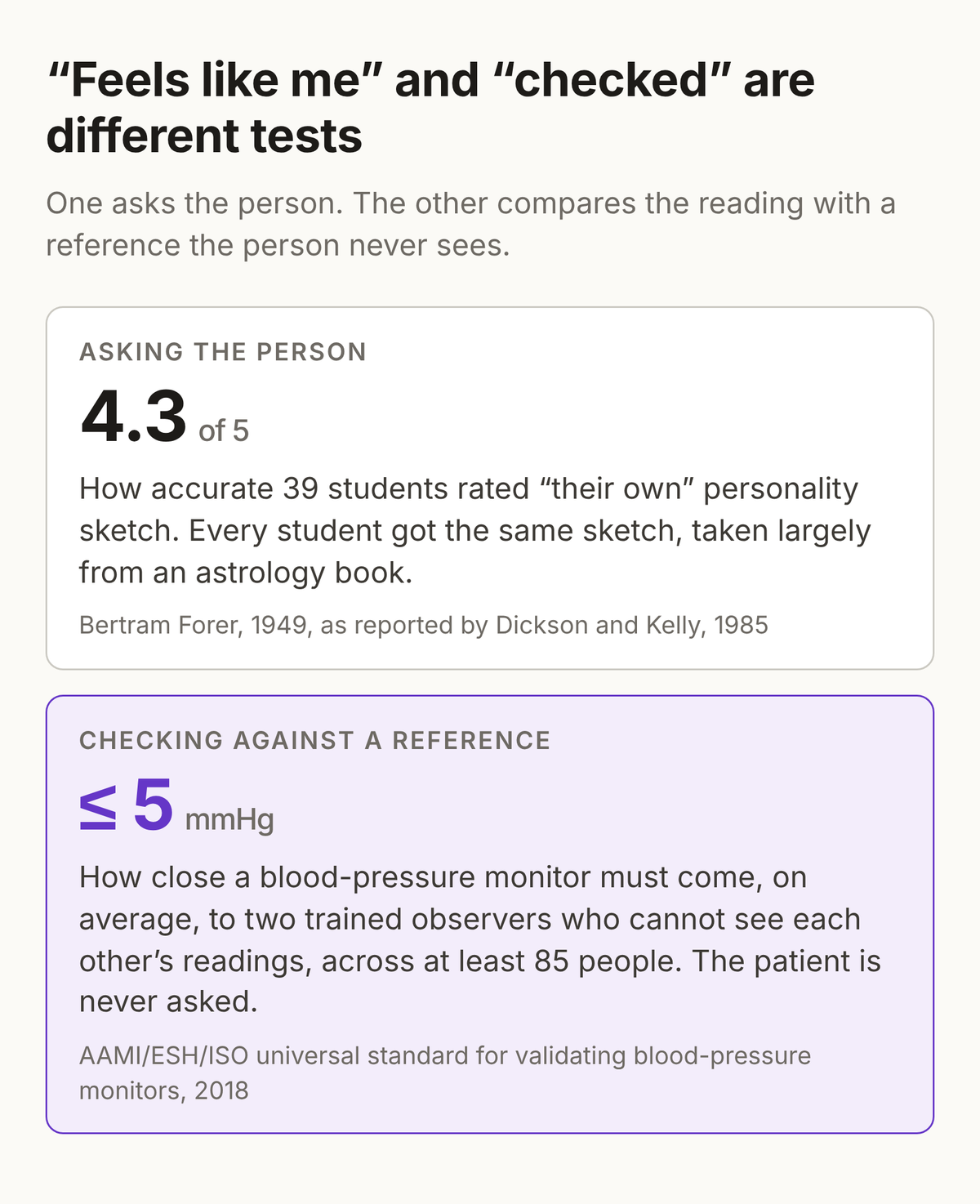
In 1949, Bertram Forer gave 39 students a personality test. A week later he handed each of them “their own” personality sketch and asked them to rate its accuracy from 0 to 5. As Dickson and Kelly reported in their 1985 review:
“The mean accuracy rating was 4.3. Nobody rated them less than 2, and only 5 subjects rated them less than 4.”
Every student had received the same text, taken largely from a newsstand astrology book. Forer’s warning, in their summary, was that this kind of personal validation “does not serve to distinguish the unique attributes of one individual from another.”
Blood-pressure monitors are approved the other way round. Under the 2018 AAMI/ESH/ISO standard, a monitor is tested on at least 85 people against two trained observers who cannot see each other’s readings or the device’s. On average it must land within 5 mmHg of them. Nobody asks the patient whether 130 over 85 feels right.
That changed how I think about a product that reads your work. Around the same time I asked: “Why should anyone have to answer, is this true for me? A measuring instrument measures.” A blood-pressure monitor does not ask you to agree with it. An instrument that is only right when you already agree is not measuring anything. On 11 August we took the “not me” button out of the design.
Asking how a reading landed is still fair, because only you know that. In the button’s place we put two plain questions: “Did this make sense?” and “Did it help?” What fails is asking you to confirm the measurement itself.
On 22 August a later reading said something “does not sound like you”, and I ruled it out again:
“What does it mean, does not sound like you? This tool has to tell the reality. You know me. You know the facts. Do a parallel read and figure out if whatever the tool is saying is valid or not valid. That is the AI’s job. Why would a person need to do that?”
That rule now runs through Sense. It checks what it says against your record, and it never asks whether a reading feels true.
What it says about your judgment
AI tools now describe people to themselves all the time. Recognising yourself in one is pleasant and proves little, because the descriptions most likely to feel true are the ones that are true of nearly everyone. And a summary built from what you typed describes how you talk to that tool, with that model, on those days.
Which summary of you have you accepted because it sounded right? Next time, skip “that sounds like me” and ask two questions:
1. Would this be true of most people who use AI the way I do?
2. What in my sessions would show this is false, and have I looked?
Try it on your last ten sessions
1. Take the last thing an AI told you about how you work.
2. Ask a colleague whether it is also true of them. If it fits them too, it is not telling you much about you.
3. Write down what you would expect to see in your sessions if it were false. Then open your last ten sessions and look.
What went into this post
- 888 messages read twice, by two reads that never saw each other’s answers
- 10 possible habits proposed and 27 ideas rejected along the way; 1 pair matched, and I rejected that one too
- 146 sessions over three months checked for change
- A 1949 experiment, a 1985 review and a 2018 medical standard read
- One product change: the “not me” button removed on 11 August
Sources
- Forer, B. R. “The fallacy of personal validation: A classroom demonstration of gullibility.” Journal of Abnormal and Social Psychology 44(1):118-123, 1949.
- Dickson, D. H. and Kelly, I. W. “The ‘Barnum effect’ in personality assessment: A review of the literature.” Psychological Reports 57:367-382, 1985.
- Stergiou, G. et al. “A Universal Standard for the Validation of Blood Pressure Measuring Devices: AAMI/ESH/ISO Collaboration Statement.” Published together in Hypertension 71(3):368-374 and Journal of Hypertension 36(3):472-478, 2018.
- ISO 81060-2:2018, Non-invasive sphygmomanometers, Part 2: Clinical investigation of intermittent automated measurement type.
