
October 22, 2026
Anthropic says your design judgment matters more than ever. OpenAI is teaching it to the model.
OpenAI grades GPT-6’s design judgment. Anthropic’s Meaghan Choi says yours matters more than ever. Four habits from her talk, and who grades yours.

On 17 August an agent told me the spacing on our sign-up questions was fine. It had a screenshot to prove it. I opened the live page and saw three problems in one glance: cramped spacing, answers split into two groups, and no way to go back once you tapped. I wrote about that week here.
I am not a designer. I am not a developer either. But building this site and an app with agents, I now make design calls every day: what a button says, which picture goes first, whether a page is ready. I caught that one. What I can’t tell you is how many I didn’t catch, or whether I am getting better at this or just faster.
So two things this month stopped me, because they give opposite answers to the same question: who decides what good looks like now?
Two labs, two bets
On 7 October, OpenAI shipped GPT-6 with Intelligent UI. Ask ChatGPT how a bike works and you get an exploded diagram with a slider. Plan a road trip and you get a map. Split a dinner bill and it builds you a calculator. “ChatGPT has predominantly been a text-based interface,” the product manager Aarush Selvan told TechCrunch. Now the model decides, answer by answer, what screen you need.
The part that stopped me is in OpenAI’s post. It trained GPT-6 “to make thoughtful decisions about content, layout, visuals, and interaction”, and graded the interfaces it made “for clarity, usefulness, and completeness.” Then, honestly: “There’s still work ahead to improve the model’s design judgment.” The model’s taste now has a report card.
On 20 October, uxcon vienna posted a talk by Meaghan Choi, a design manager at Anthropic who works on the Claude apps: Design Will Never Be The Same. One slide says it in seven words: “Your design judgement is more important than ever.”
OpenAI closes its post with a promise: “Instead of people adapting to software, software will adapt to people.” The last time software tried that, it was a paperclip with eyebrows asking if you were writing a letter. Microsoft switched Clippy off by default in 2001. GPT-6 is far better at guessing than Clippy ever was, which is exactly why the question matters now.
| OpenAI: Intelligent UI | Anthropic: Meaghan Choi | |
|---|---|---|
| Who puts the screen together | The model, for every answer | A person, in code that ships |
| What people still own | The parts the model may use | What gets built, and when it is ready |
| Who checks the judgment | Training and evals, “for clarity, usefulness, and completeness” | Mostly nobody |
| The fear | Answers stuck as walls of text | “a world of joyless slop” |
Read closely, the bets meet in the middle. OpenAI’s designers didn’t disappear. They built the parts, a library that “gives each response a familiar design foundation while leaving the model room to decide how the pieces fit together.” The people moved up a level, to deciding what is worth making and when it is good enough. Choi’s talk is a field guide to that level. It is about designers, but swap in “anyone who works with Claude” and it still holds. Four points stood out.
1. Your demo proves nothing
A year ago, Choi says, much of her job was “convincing designers and design teams to try out AI coding.” At her last company she “had to beg to get access to the codebase.” That fight is over: in a Designer Fund survey, “65% of designers said they’re taking on more product or engineering responsibilities.”
The catch is that when anyone can build a working demo over a weekend, a working demo stops meaning anything. Choi is blunt about what lands on her desk: “I get a lot of what I consider idea slop.” Her slide: “Just because you can build it, doesn’t make it a good idea.”
The hardest demo to judge is your own. In a 2012 study, people valued storage boxes they had assembled themselves far above identical ones built by someone else. Psychologists call it the IKEA effect. Ten minutes of prompting is apparently enough labour to fall in love.
Apple TV’s The Studio opens with a new studio head whose first job is Kool-Aid: The Movie. Nobody asks whether the world needs it; they argue about how many explosions it should have. That is idea slop from the inside: everyone busy, nobody asking “should this exist?”
Her best story shows the other side. Nate, a designer at Anthropic, noticed Claude made far better screens “when it has access to my design system,” built a skill for it, and shared it. Sales and marketing started using it for slide decks. “He unlocked a use case almost accidentally just by building a prototype and making it available.” That became Claude Design. The difference from idea slop was never the demo. Other people kept coming back to it.
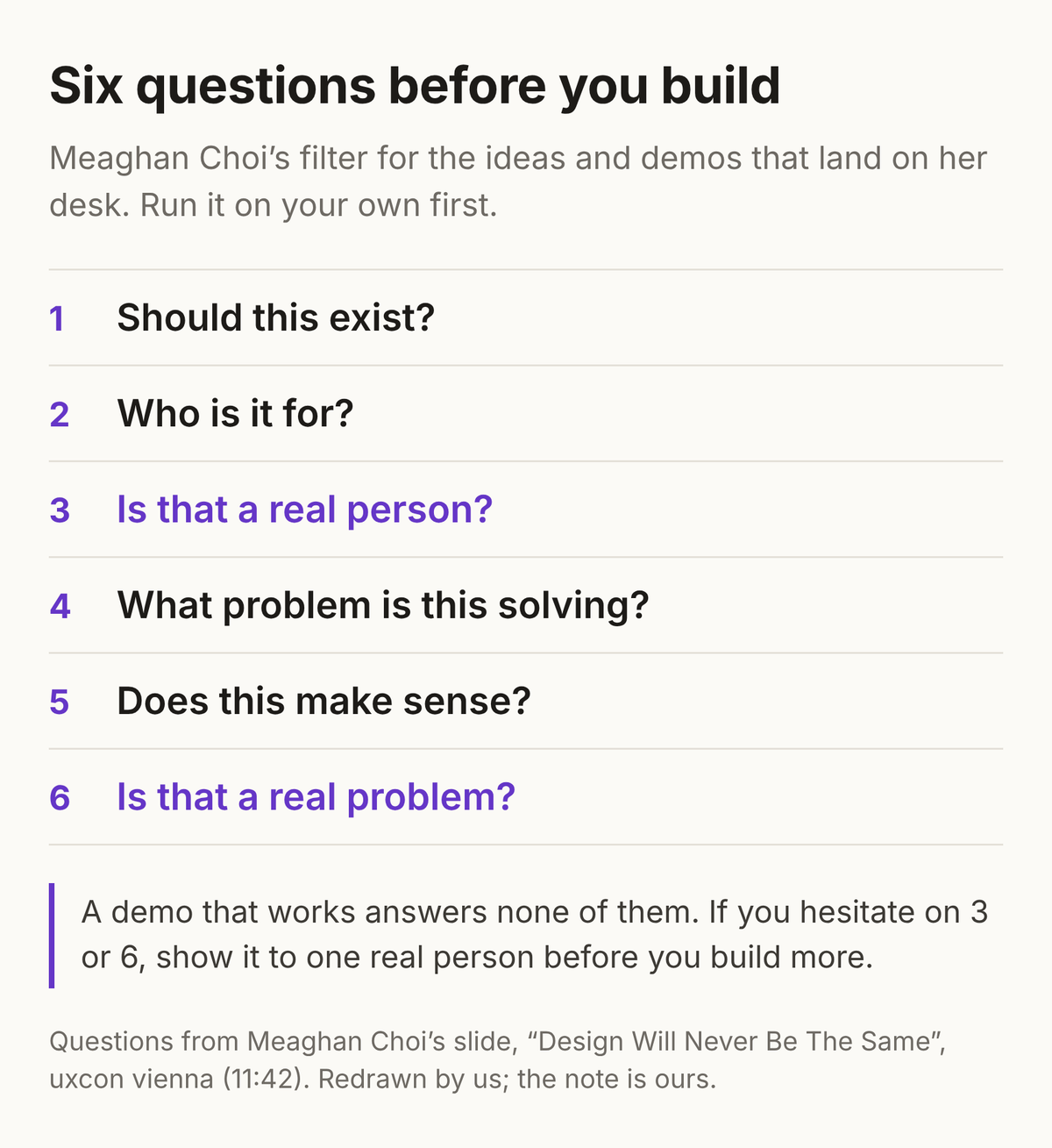
Try it: take the last thing you built with AI and answer her six questions honestly. If you hesitate on “is that a real person?”, show it to one before you build more.
2. Set the bar before you start
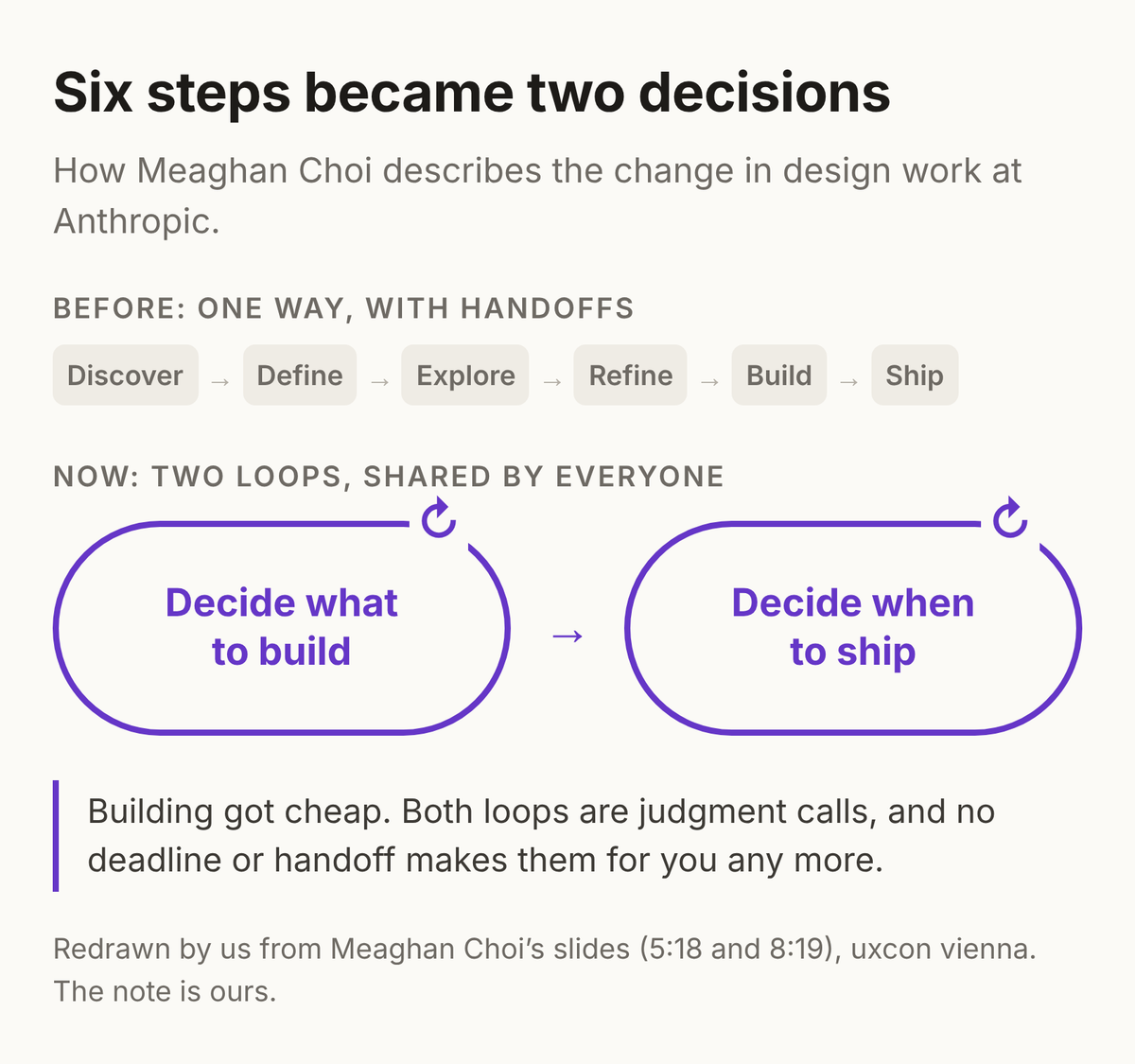
In the third season of The Bear, a sign on the kitchen wall reads “Every second counts.” That is the brief in most teams now. Choi’s third shift is “speed is the default”: months became days.
Speed takes away the old signal for done. When engineering set the dates, the calendar decided for you. Now, she says, the person who builds it decides when it is good enough. Her example is the Claude Code desktop app, shipped three times. Late 2025 was a one-week sprint to test “just a hypothesis”: would a window beat the command line? Early 2026 was a redesign where “the launch bar for this one was almost entirely driven by design.” Mid 2026 was about speed, with the app starting about twice as fast.
Same product, three different bars. Each one was named before the work started.
Try it: before your next piece of work with an agent, write one line: “This ships when ___.” When the agent says it is done, check against your line, not against how it feels.
3. Polish is not judgment
“Yes we should all be coding and I hope you all are but I think coding is honestly no longer enough.” Choi is tired of the word “taste”, so she names four things instead: trying widely different ideas, hiding complexity from the person using it, keeping the product feeling like one thing, and fit and finish.
OpenAI’s launch post has a side-by-side that shows why this matters. Asked to plan a ten-day Pacific Northwest road trip, the old text answer argues with you: “I’d resist trying to cover all of Washington and all of Oregon.” It ends: “Ten days is enough to experience the PNW rather than merely collect destinations.” The new answer gives you an interactive map, day cards, a budget table and a form. It looks far better. The opinion is gone.
For many people the map is more useful. But polish and judgment are different things, and a better-looking answer can quietly carry less of one. Choi’s closing slide shows a machine pouring identical blobs onto a conveyor belt: “if we don’t do this well we are going to end up in a world of joyless slop.”
Try it: ask for three versions that are deliberately different before you polish any of them. Then ask yourself which one you would have settled for if you had only seen the first.
4. There’s crying in production
In A League of Their Own, Tom Hanks’s manager shouts that there’s no crying in baseball. Choi’s most human moment is the opposite. Answering a question at the very end, she remembered her first production outage: “I was crying i was like ‘Oh my god I broke our app.’” Then the line an engineer once gave her: “you’re not coding enough if you haven’t caused an incident.”
There is crying in production, and that is fine. Approvals and automated checks make sure one mistake doesn’t sink anything. They don’t make sure you learn from it. The same wrong assumption tends to come back in a different costume.
Try it: after your next slip with an agent, big or small, write three lines: what I assumed, what happened, what I check now. Read the list at the end of the month.
The bottom line
OpenAI is betting design judgment can be taught to a model. Anthropic’s designers are betting it is the thing people must hold on to. Both may be right. The model will get better at putting screens together, and the people around it will spend their days on what is worth making and when it is good enough.
Here is what bothers me. GPT-6’s design judgment is graded in training, and OpenAI publishes how far it has to go. Choi says ours matters more than ever. Nobody grades it. “More important” is not the same as “getting better”, and nothing in either bet tells you which way yours is going.
Choi’s advice on tools, by the way, was to wait three or four months before switching to anything new. Tools change every quarter. The calls you make with them don’t. That is the part we are building Sense for: not a better model, a better you, and a way to know it.
Watch it if you design, write or build with AI and feel what she opens with: “design has both never been so stressful and also never been so fun.” The six questions are at 11:42, Claude Design at 12:38, the desktop app at 18:53 and the crying story at 37:14.
Sources: Meaghan Choi, Design Will Never Be The Same, uxcon vienna, posted 20 October 2026. OpenAI, GPT-6 and Intelligent UI for everyone, 7 October 2026, and TechCrunch. Robyn Park, AI in Design 2026, Designer Fund. Norton, Mochon and Ariely, “The IKEA effect: When labor leads to love”, Journal of Consumer Psychology, 2012.
