
October 23, 2026
AI is removing the people who told you your work was good
Companies hire fewer beginners and give managers more people to look after. Recruiter Deepali Vyas explains why, and what it means for your own growth.


Earlier this year I measured a year of my own work with AI: 487 sessions, 3,138 messages. By the end I was using it far more than at the start. The way I briefed it, checked it and corrected it had barely moved. Nobody told me. Nobody could have. The agents only ever told me the work was done.
Then I watched a talk by Deepali Vyas. She finds senior data and AI leaders for big companies, at a firm called ZRG Partners, so she sees how companies are reorganising around AI before most of us do. Two of her points matter to anyone who works with AI.
First, companies have quietly stopped hiring beginners, because AI now does beginner work. Second, managers now look after so many people that they have little time to watch any one of them. Put those together and fewer people are left to tell you whether your work, and the decisions behind it, are any good. That is what this post is about, and what you can do about it.
1. Companies stopped hiring beginners
One slide, three short lines:
“Nobody fired them. We stopped hiring them.”
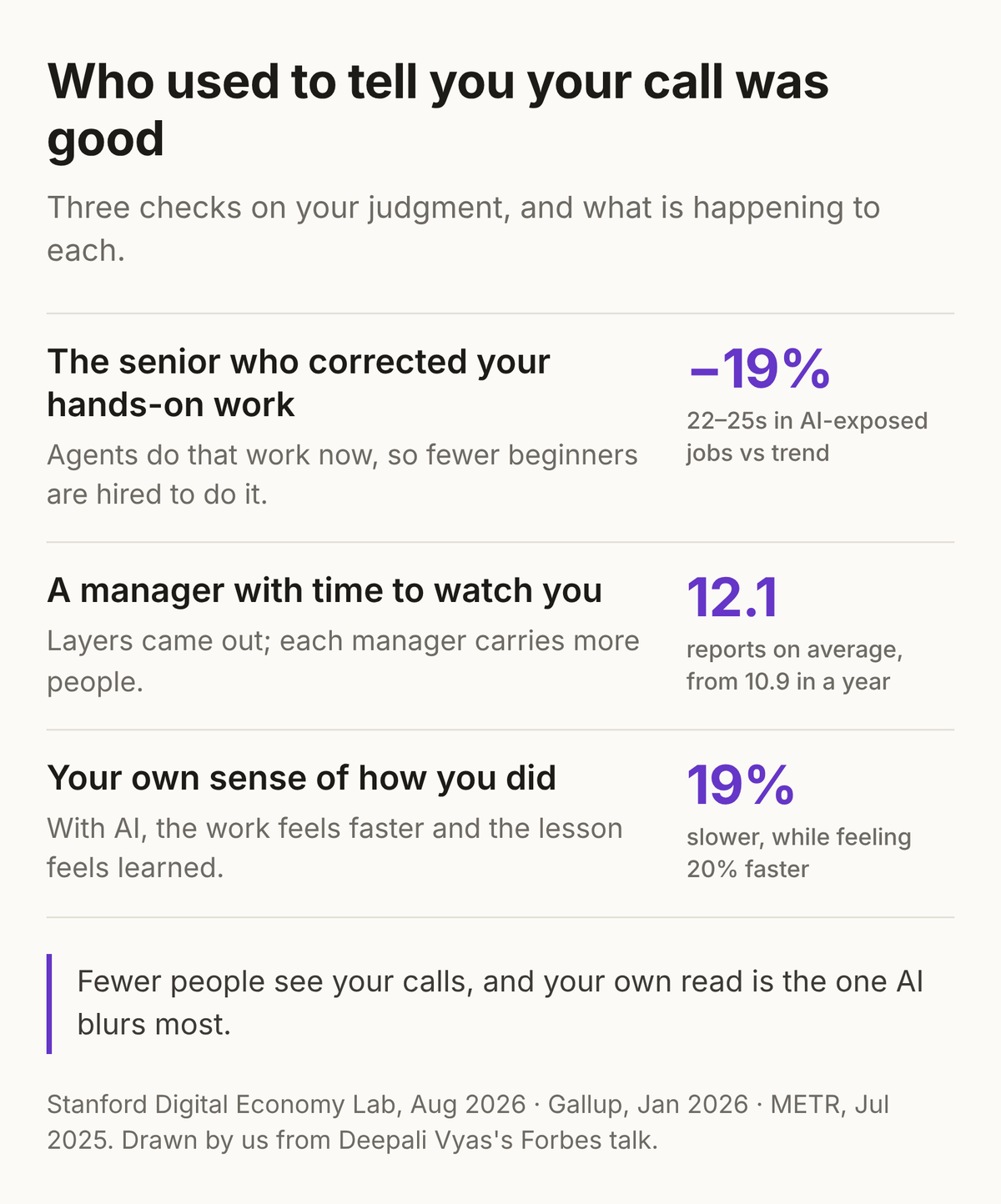
She means people aged 22 to 25 in the jobs most exposed to AI. Stanford’s latest Canaries in the Coal Mine update puts their employment 19% below trend, up from 15% a year earlier, almost entirely because fewer are hired. In software, Indeed found only 4.5% of job postings in early 2026 were entry level. Senior roles were 69.3%.
Her question to the room: “who’s going to run your company in 2035?” Mine is smaller. What was the bottom rung actually for?
In The Karate Kid, Mr. Miyagi has Daniel wax cars and paint a fence for days. Daniel is sure he’s being used as free labour. Then Miyagi throws a punch, Daniel blocks it, and the chores turn out to have been the training. Junior work did that for most of us. It was dull, and someone senior looked at it and told you, line by line, where your judgment was off.
AI now waxes the car. The work still gets done. The person who would have learned from it, and the person who would have corrected them, are no longer in the same room. And this isn’t only about 23-year-olds. At any level, the hands-on part of your work is what agents take first, and it was where most of your feedback came from.
Try it: write down the name of the last person who told you a call of yours was wrong, and the date. If it takes you a while, you have the gap she is describing.
2. Managers have too many people to watch
The second squeeze is in the middle. As layers come out, each manager carries more people. Gallup puts the average at 12.1 direct reports, up from 10.9 in a single year. The median is still about six, which means some teams are now enormous: 13% of managers have 25 or more. Vyas called twelve “insane.”
Danny Ocean pulled off a casino job with a crew of eleven, and the whole film is him watching each of them work. The average manager now has a bigger crew than Danny Ocean, and nobody is watching the tapes.
Vyas says the job changes. The reports and updates go to AI; she described having Claude prepare the morning reports, writing “a little program”, and going to sleep. What’s left is coaching, which “requires a lot more human judgment.” I agree. I just don’t see how it works yet. A coach watches you play. With twelve people and agents doing half of each person’s work, what does the manager watch? The output, which looks the same whether the person made good calls or the agent did.
That isn’t a guess. In Anthropic’s own randomised trial, developers who learned a new library with AI help scored 50% on a mastery quiz. Those who learned by hand scored 67%. Their code worked either way.
Try it, if you manage people: in your next one-to-ones, skip “what did you ship?” Ask: “Tell me one call this week where you overruled the AI, and why.” The answers show more judgment than the work does.
3. People who work alone have nobody to check them
Then she asked where the squeezed managers are going. Someone in the audience called out: starting their own businesses. “You’re losing them to the company of one,” she said, people who want “a portfolio career” instead of one logo.
I know this one from the inside. In Cast Away, Tom Hanks’s only colleague for four years is a volleyball called Wilson. Wilson is a great listener. Wilson never once tells him his raft design is wrong. Agents are very good Wilsons. They keep you company all day, and they say “done.”
Filling that silence yourself is harder than it sounds. In METR’s 2025 study, experienced developers felt AI made them 20% faster; measured, it made them 19% slower. In METR’s 2026 survey, people said AI makes them about 3x faster, and the researchers warn that self-reports like that are likely overstated. Whatever the real number is, our own sense of it is the part AI blurs.
Try it: fifteen minutes every Friday. Pick one call from the week you’d make again and one you wouldn’t, and write down what you saw at the time. After a month, read them together.
4. Years of experience mean less now
Her best moment is a client asking for seven to ten years of generative AI experience. “Well, hell,” she says. “ChatGPT came out in 2023.” It’s like hiring for a decade of iPhone experience in 2010.
The joke has a point. Years of experience used to stand in for judgment, because you couldn’t fake ten years of making calls. Now the tool makes the work look experienced on day one, so years tell an employer less every month.
Her slide for early-career people says “bring proof”, meaning work they can show, “including work they did with AI.” I’d go one step further. The proof that matters is not the work. It’s the decisions behind it: what the agent proposed, what you kept, what you changed, and how it turned out.
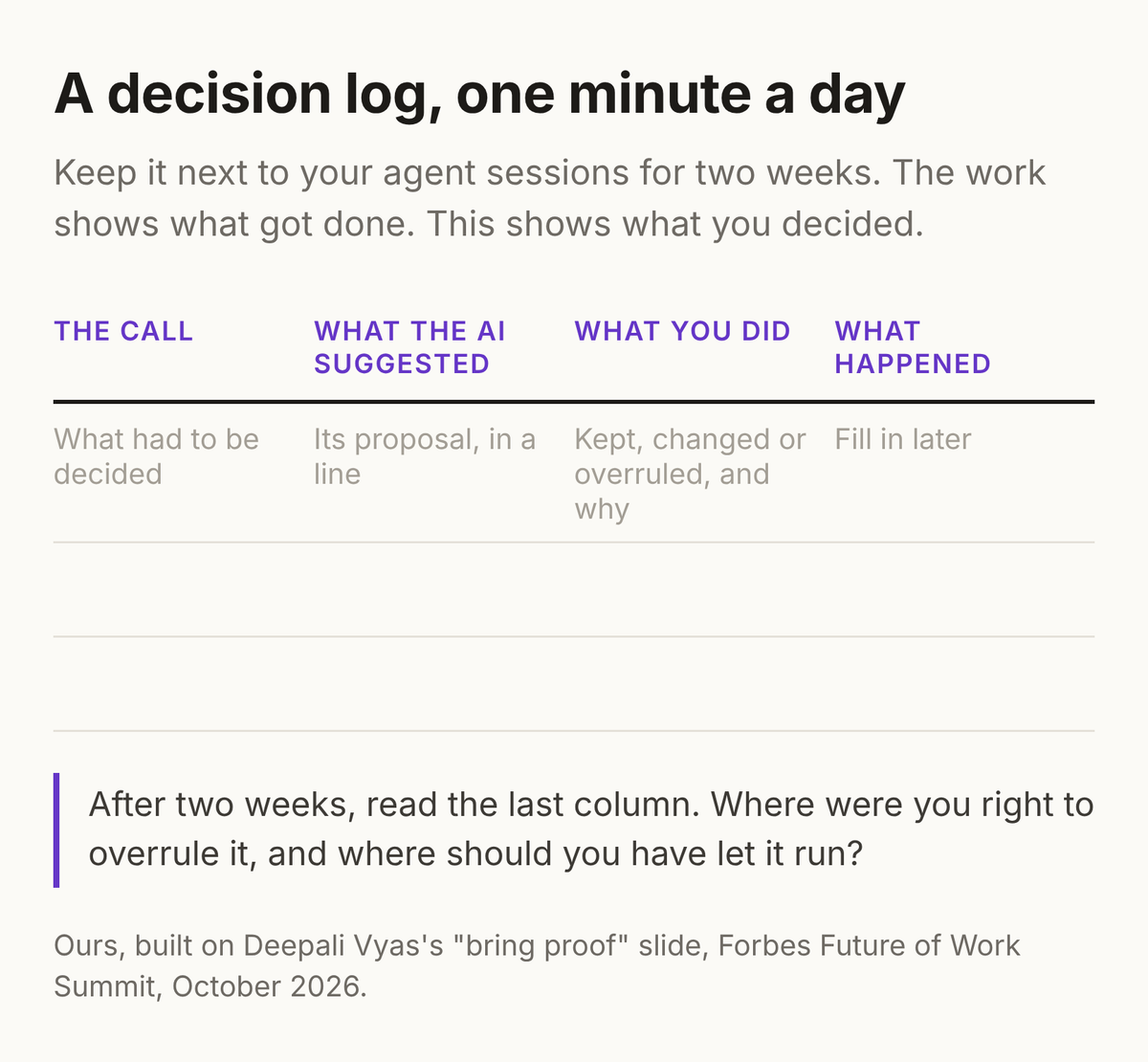
Try it: keep a decision log next to your agent sessions for two weeks. Four columns, one minute a day. It is the only record of your judgment that exists.
5. Knowing AI gets you shortlisted. Judgment gets you hired.
| What used to check your judgment | What’s happening to it | The number |
|---|---|---|
| The senior who corrected your hands-on work | Fewer beginners are hired to do it | 19% below trend for 22–25s in AI-exposed jobs |
| A manager with time to watch you | Each manager carries more people | 12.1 reports, from 10.9 in a year |
| Years of experience | The tool makes day-one work look experienced | “Seven to ten years” asked of a tool from 2023 |
| Your own sense of how you did | AI makes work feel faster and lessons feel learned | Felt 20% faster, measured 19% slower (2025); said 3x faster, likely overstated (2026) |
One line from her talent slide is the one I keep coming back to:
“AI fluency gets you on the shortlist. Judgment, trust and communication get you the offer.”
A 400-day Duolingo streak can still leave you pointing at the menu in Madrid. A streak is fluency you can count. Ordering dinner is the skill. AI fluency is the same: easy to see, easy to test, and now everyone has it.
Judgment used to be seen by other people: the senior who corrected your junior work, the manager with time to watch, the years that made you hard to fool. Her talk shows all of them thinning at once. Nobody planned it. It’s what happens when the budget moves to compute and the org chart gets squeezed from both ends.
So the question I started with, am I getting better, or just using AI more?, isn’t a founder’s quirk. Everyone who works with agents will have to answer it for themselves, because fewer people will be around to answer it for them. That’s what we’re building Sense for: a way to see your own calls, and whether they’re getting better, without waiting for someone else to notice.
Watch it if you hire people, manage people, or wonder what a career looks like when the first rung is gone. The 2035 question is at 5:15, the green-room story about juniors managing agents at 6:17, her overnight Claude story at 7:32 and the “company of one” at 11:23.
Sources: Deepali Vyas, How AI Is Rewriting The Corporate Org Chart, Forbes Future of Work Summit, October 2026. Brynjolfsson, Chandar and Chen, Canaries in the Coal Mine, August 2026 update, Stanford Digital Economy Lab. Gallup, span of control, January 2026. Indeed Hiring Lab, The labor market is tilting toward seniority, July 2026. Shen and Tamkin, AI assistance and coding skill formation, Anthropic, January 2026. METR, early-2025 AI and experienced open-source developers, July 2025. METR, AI usage survey, May 2026.
