
October 20, 2026
Matt Pocock stopped writing code. The skill he says matters now is yours to practise.
Matt Pocock stopped writing code. The gist of his talk with Nate Herk, what he changed his mind about, and six practices to start this week.


Nate Herk’s podcast posted Matt Pocock: The Most Valuable Skill to Learn in the Age of AI on 16 October. It runs 45 minutes. Matt teaches TypeScript and AI engineering at AI Hero, and his skills for coding agents, /grill-me above all, are some of the most copied around.
Most of the episode is about making agents work better. We watched it for the other half: what Matt does with his own head. Below is the gist, what he changed his mind about, and six practices you can start this week, each with a “Try it”.
The gist
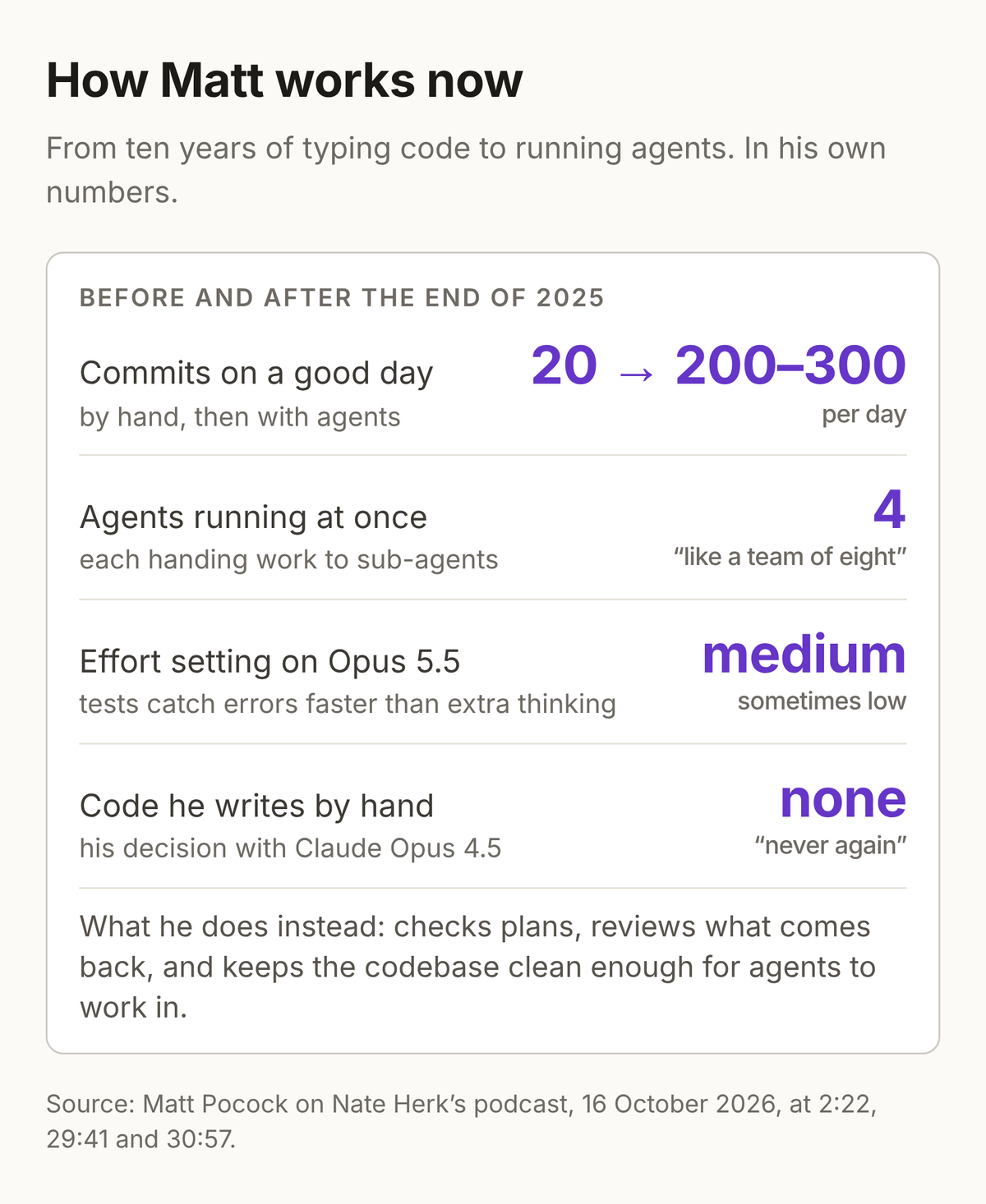
Matt coded by hand for about ten years, eight of them professionally, and called himself a born skeptic of AI. At the end of 2025, with Claude Opus 4.5, he decided he would never write a line of code himself again (2:22).
What replaced typing was communication. “The best way to get the best work out of agents is to tell them what you care about” (4:26). His model is a company with 100 junior developers: you raise the floor so the weakest one still does good work, with tests, checks and a clean codebase. The books on that were written twenty years ago, and he says “they feel like they were written last week” (6:05).
The line we kept coming back to is about people, not agents. On what sets the best builders apart: “the clarity of their thinking ends up in the product they create” (23:44).
What he changed his mind about
The most useful thing in the episode is how often Matt says he was wrong. Every row below is a judgment call he made, saw fail or cost too much, and reversed.
| He used to think | Now he thinks | What changed his mind |
|---|---|---|
| AI is hype, like Web3 and crypto | He will never write code by hand again | Claude Opus 4.5, at the end of 2025 (2:22) |
| Trust what the agent explains | Use it to get oriented, then read the source | Being a skeptic; his /teach skill fetches primary sources (8:13) |
| Specs are the new code | The code is the agent’s environment, so keep it clean | Months of watching his video editor get worse (28:07) |
| High effort gets the best results | Medium, sometimes low, effort on Opus 5.5 | Tests and small modules catch errors faster and cheaper (29:41) |
| Give AI your most ambitious work | Give it the boring work that is easy to check | Sonnet 5.5 drafting the articles he used to pay for (40:03) |
He also gives the scale he works at now: four agents at once on long-running goals, each handing work to sub-agents, and 200 to 300 commits a day where 20 used to be a good day (31:40).
What it asks of the human
1. Get grilled before you build
Matt quotes The Pragmatic Programmer: no one knows exactly what they want. When you leave something unsaid, the agent doesn’t stop and ask. It fills the gap, and you find out later. So before any code, his /grill-me skill has the agent “interview me relentlessly about the thing that we’re trying to build” (17:01): deployment, security, the edge cases.
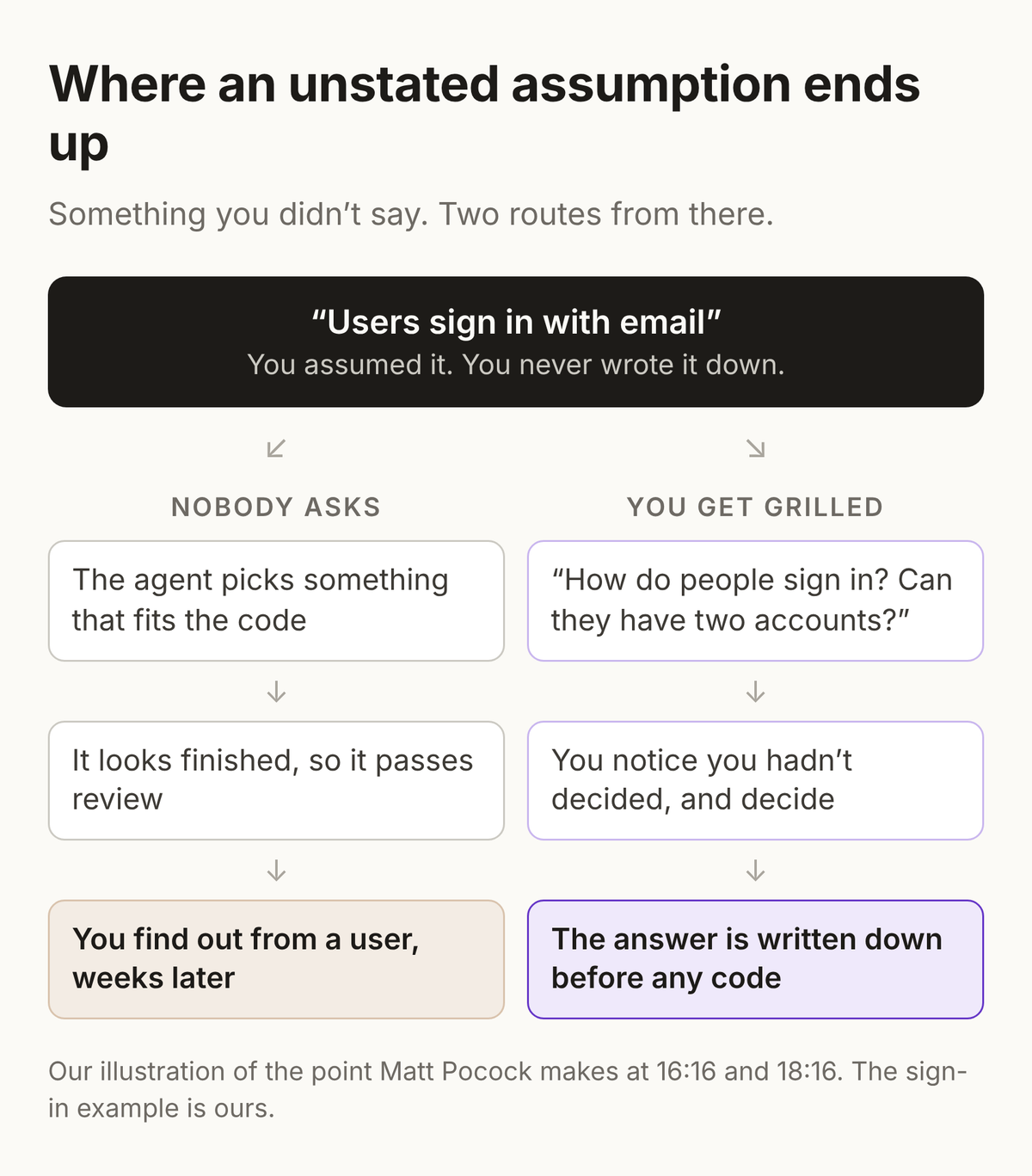
The skill is not the point, though. He says so himself:
“The skill is being aware of unknown unknowns, of knowing that you could be missing things in your design and not trusting that you’ve come up with a complete design.” (18:16)
That is a judgment habit, and it works the same with a person asking the questions. Matt has also written how it goes wrong, on his /grill-me page: “The failure mode is passivity: answering ‘agreed, agreed, agreed’ for forty questions and coming out with a plan the agent wrote and you nodded at.”
Try it: install Matt’s skills (Claude Code: claude plugin install mattpocock-skills@claude-plugins-official) and run /grill-me before your next piece of work that will take more than an hour. Answer in your own words, never “yes, that”. Afterwards, count the questions you had not thought of. That number is your unknown unknowns for that task.
2. Use the AI to find the door, then read the source
Matt doesn’t trust what an agent tells him from memory. “You should always be skeptical over anything that anyone tells you” (7:08). His /teach skill fetches high-trust primary sources and breaks them down with quotes and attribution. Then: “I will just get it to introduce me to a topic and then I’ll just go and read the primary source” (8:13).
The skill’s own instructions explain why that matters, in a passage worth reading even if you never install it. It separates fluency, being able to recall something in the moment, from storage strength, still knowing it next month, and warns that “fluency can give the user an illusory sense of mastery”. An AI explanation gives you fluency. Reading, recalling and using it gives you storage.
Try it: next time you meet a topic you don’t know, ask for a short orientation and the three best primary sources, with quotes. Read one of them yourself. The next morning, write three things you learned without looking. If you can’t, you had fluency.
3. Say it in one word, and the same word everywhere
Matt borrows “ubiquitous language” from Domain-Driven Design: the word for a thing is the same in the code, the database, the screen, the client meeting and the user’s head (24:09). His /grill-with-docs skill builds that glossary as you go. The example in his repo:
Before: “There’s a problem when a lesson inside a section of a course is made ‘real’ (i.e. given a spot in the file system).” After: “There’s a problem with the materialization cascade.”
Agents read it faster, but that is not why it belongs here. Naming a thing forces you to decide what it is. A vague term is usually a decision you haven’t made yet. This is where “the clarity of their thinking ends up in the product” happens.
Try it: write down the ten words your current project depends on most, with one line each on what they mean. Then look for two words used for the same thing, or one word used for two things. Each one you find is a decision to make, not a typo to fix.
4. Notice sooner when your own call is going wrong
The war story in the middle of the episode (26:36) is the most honest part. After Sean Grove’s talk The New Code, arguing that specs are the new code, Matt tried building his own video editor from detailed specs alone. “I just saw the code getting worse and worse and worse, and the agent would produce worse and worse results, and I tried this for months” (28:07).
His conclusion is about agents: the code is the environment the agent lives in, and you can’t hand it a burning house. Ours is about the months. A very good developer, watching closely, took months to give up on an approach he had chosen. That isn’t carelessness. It is what happens to everyone when there is no point set in advance at which the evidence counts.
Try it: pick one way of working you took up in the last three months: a new tool, a workflow, a rule. Write one sentence: “If this is wrong, by [date] I would see ___.” Put the date in your calendar.
5. Learn the brake before the accelerator
Matt credits Lauren Tan with an idea he calls the trust ladder, and explains it with driving (36:53): “When you learn to drive, what’s the first pedal you learn? … You learn the brake first. You learn how to stop.” Start in an empty folder, watch every step, and add agents, skills and integrations only as trust is earned.
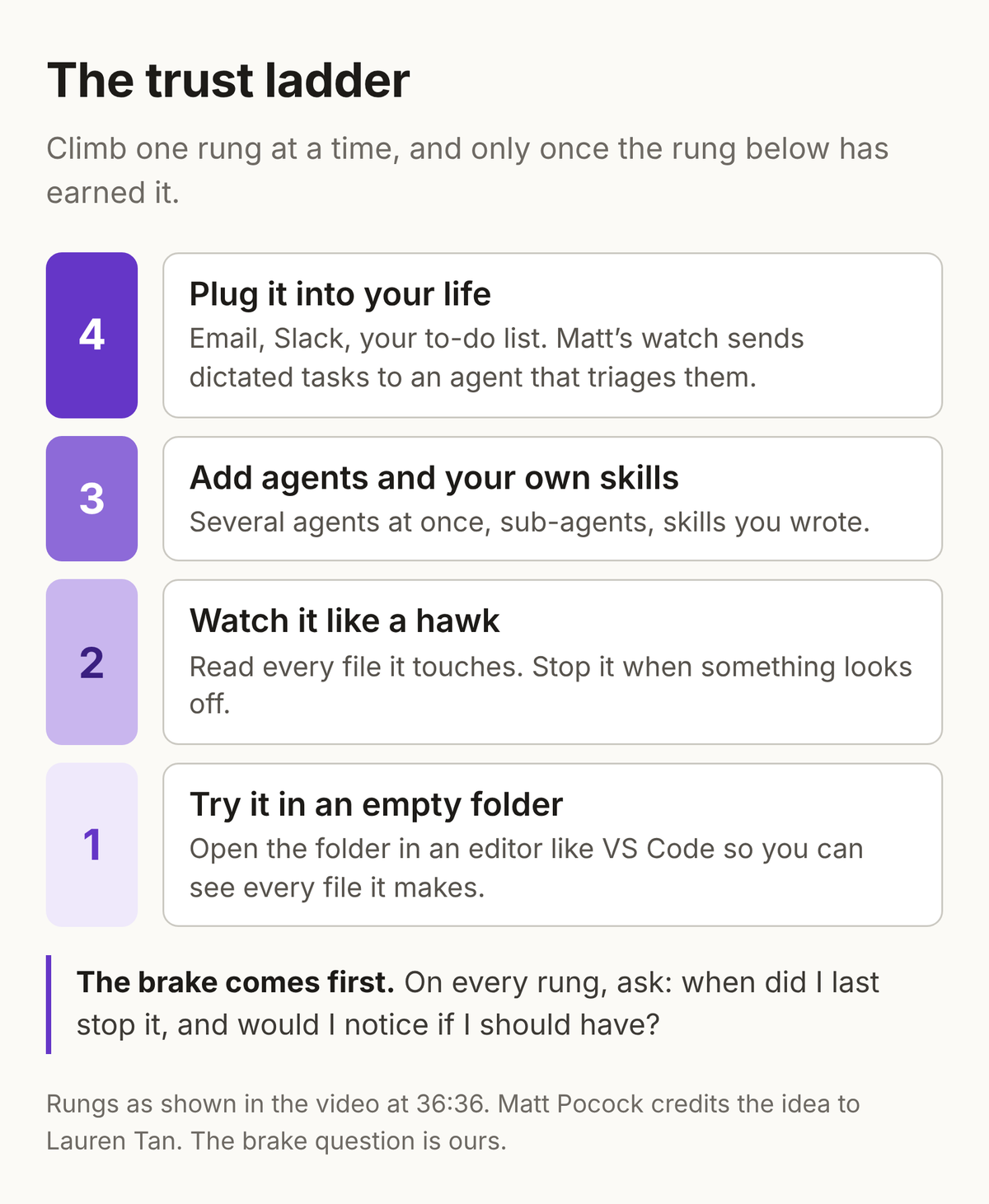
Read that next to the 200 to 300 commits a day. Matt can run that fast because he climbed the ladder over months and knows where his brakes are: tests, small modules, an agent that can see the running app. The speed is the result, not the starting point. The question for the rest of us is which rung we are actually on, and whether we got there by climbing or by skipping.
Try it: for each AI tool you use, name your rung. Then answer one question: when did you last stop an agent mid-run because something looked wrong? If you can’t remember, you may be driving without having learned the brake.
6. Hand over what you hate, keep what you want to get better at
Matt pushes back on the advice to give models your most ambitious work: “give it your most menial boring work, give it the stuff that you hate doing” (40:03). He used to pay people to write his newsletters. Now Sonnet 5.5 writes a first draft from his videos and he edits it, and he enjoys the work more (41:01).
That is a good rule with one condition inside it. Writing was boring to Matt, and his craft is teaching on video. For someone whose craft is writing, the same handover would give away the thing they are trying to get better at. “Boring” is personal. So is “easy to check”.
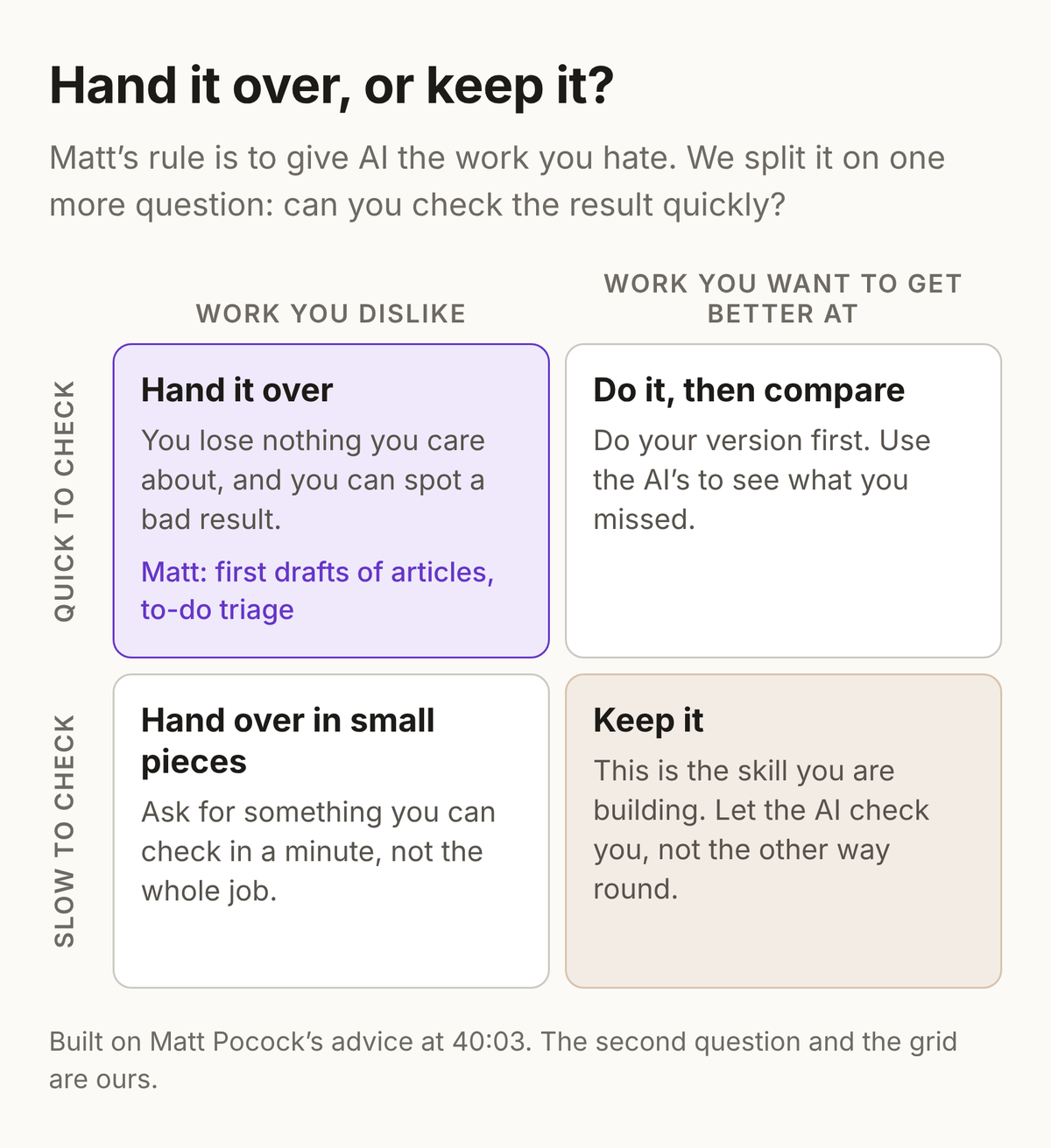
Try it: list five things you did with AI this week and place each one on the grid above. Hand over freely in the top left. In the bottom right, do it yourself first and use the AI to check you, not the other way round.
A week to try it
One practice a day, about twenty minutes each, inside work you are already doing. None of them needs a new tool except Monday’s, and Monday works with a colleague asking the questions instead.
| Day | Practice | What to write down |
|---|---|---|
| Monday | Get grilled with /grill-me, or by a colleague, before a task that will take more than an hour | How many questions you had not thought of |
| Tuesday | Learn something new: AI for orientation, then one primary source you read yourself | The next morning, three things you remember without looking |
| Wednesday | List the ten words your project depends on, with one line each | Any word used for two things, or two words for one thing |
| Thursday | Pick one way of working you took up in the last three months | “If this is wrong, by [date] I would see ___” |
| Friday | Name your rung on the trust ladder for each AI tool | When you last stopped an agent mid-run |
| Weekend | Place five of this week’s AI tasks on the hand-over grid | One task you will take back, and one you will let go |
Watch it if
- You have heard of /grill-me but never seen the thinking behind it. Start at 16:16.
- You are tempted by spec-driven development. The war story starts at 26:36.
- You are new to agents, or teaching someone who is. The trust ladder starts at 36:01.
The sponsor segment runs from 8:28 to 9:37, and the host’s own plug from 20:27 to 20:53.
Matt Pocock: The Most Valuable Skill to Learn in the Age of AI, Nate Herk | AI Automation, 16 October 2026. Matt’s skills, including /grill-me, /grill-with-docs and /teach, are at github.com/mattpocock/skills. Sean Grove’s talk is The New Code on the AI Engineer channel. The trust ladder is Matt’s telling of an idea he credits to Lauren Tan.
